Best Time to Visit Rwanda: Weather and Climate Guide
A guide to the best time to visit Rwanda is during the dry season but Rwanda can be visited at any time. The weather in Rwanda depends on the month, on the altitude, on the side of the mountain you are standing on and even on the hour of the day. A morning that begins clear in Musanze may be overcast by midday, a dry month can include a heavy shower in the Nyungwe forest, and a rainy month can have long sunny spells in Kigali. Knowing how the climate actually behaves lets you plan activities, pack correctly and judge risk.
This guide is seasons in detail, gives a month-by-month table of conditions, explains how the climate differs between the volcanoes, the rainforest, the capital and the eastern savannah, shows how rain affects trekking, views and photography, summarises what long-term records say about changing rainfall and ends with packing advice and planning strategies for weather risk.
The Big Picture: A Mild Highland Climate
Rwanda is a high country, with a mean elevation of about 1,598 metres and a lowest point at about 950 metres, so its climate is a highland tropical one: mild, with moderate temperatures and distinct rainy and dry seasons. The country has two rainy seasons and two dry seasons in a year, and rainfall is the main variable. Temperature changes little from month to month in any one place, but it changes a lot with altitude and region.
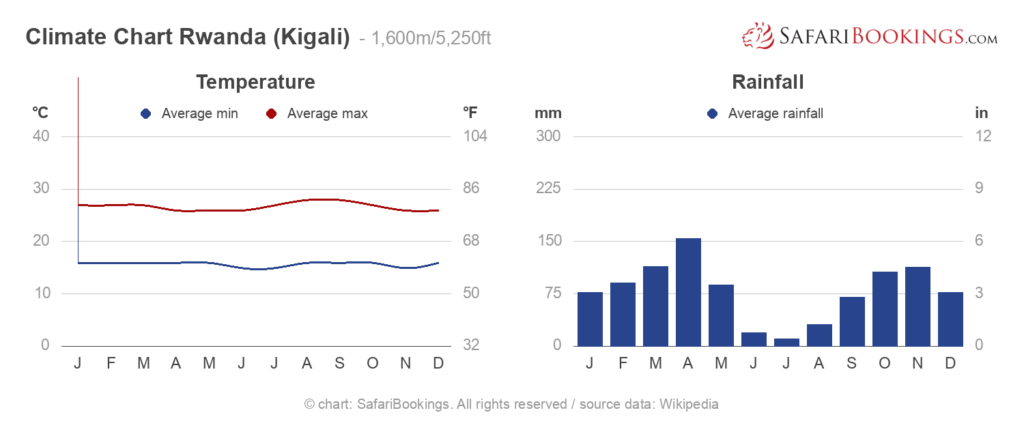
Climate guides describe the year as divided into four seasons: the long rains from March to May, the long dry season from June to September, the short rains from October to November and a short dry season from December to February. These seasons are often irregular, and a rainy season may drag on into the dry season or the reverse.
Month-by-Month Weather
| Month | General Conditions | Notes for Visitors |
| January | Short dry season, with little rain and sunny spells | Good trekking conditions and a busy holiday tail |
| February | End of the short dry season, with rain beginning to increase | Often superb dry trekking early in the month, with showers later |
| March | Start of the long rains, with increasing and persistent showers | Muddier trails and cloudier views |
| April | Peak of the long rains, the wettest month | Heavy rain, deep mud and the fewest visitors |
| May | Long rains continuing but easing toward the end | Greenest landscapes and quiet trails |
| June | Long dry season begins, with clear skies | Ideal trekking conditions return |
| July | Dry, with sunshine and long dry spells | Peak season, with the best views |
| August | Dry, with occasional short showers in the highlands | Peak season, with firm trails |
| September | Dry season ends around mid-month, with short rains beginning toward the end | Still excellent for trekking early in the month |
| October | Short rains begin, with bursts of rain and sunshine | Greener, with fewer visitors |
| November | Short rains, with rainfall remaining high | Showers, mud and quiet trails |
| December | Rain levels drop as the short dry season begins | Improving conditions, with Christmas demand |
Seasons in Detail
The long rains, from March to May, bring the most rainfall of the year, with the heaviest period in April. Rain can be heavy and persistent, and for some periods it may fall every day, though in most places downpours are followed by clearing skies. The landscape turns deeply green, rivers rise and trails become muddy.
The long dry season, from June to September, is the most consistently pleasant. Skies are clear, sunshine is plentiful and in the middle of the season long spells without rain are common. It does not mean no rain, and sporadic showers occur, particularly in the highlands of Volcanoes National Park and Nyungwe, but they are usually downpours lasting a few minutes to a couple of hours.
The short rains, from October to November and sometimes extending to mid-December, are lighter and less predictable than the long rains, with bursts of showers and sunshine. The short dry season, from December to February, is a relatively dry period that offers good trekking conditions and a busy Christmas and New Year, with rain returning in February or March.
Regional Climates
The key rule is that the higher you go, the cooler and wetter it gets. If you are planning to be in more than one region, pack for the coolest and wettest, and expect to peel layers off in the east.
| Region | Typical Weather | Rain Pattern |
| Volcanoes National Park and Musanze | Cool, often misty, with strong sun when clear | Frequent short showers even in the dry season, heavier in the rains |
| Nyungwe and the south-west highlands | Cool and humid, with morning mist | Rain possible in any month, with the heaviest rains in the long and short rainy seasons |
| Kigali and the central highlands | Mild, warm by day and cool at night | Two rainy seasons and two dry seasons |
| Lake Kivu | Mild and pleasant, with lake breezes | Similar to the central highlands, with some local storms |
| Akagera and the eastern plains | Warmer and drier, with hot afternoons | Lower and more variable rainfall |
Temperature: Cool Mornings, Warm Afternoons
Rwanda’s temperatures are moderate year-round. The warmest weather is in the east, around Akagera, and the coolest is on the volcano slopes and in the Nyungwe highlands, where nights can be cold and the highest peaks can have frost. Kigali and Lake Kivu are warm by day and cool at night, and a light jacket is usually needed in the evening.
During the dry season, mornings are cool, and clear days warm up quickly, with strong sun at altitude. In the rainy seasons, cloud cover keeps daytime temperatures moderate, and rain can make it feel colder. Because of the altitude, sun protection is as important as rain protection, and sunburn is a common surprise on clear days.
How Rain Affects Gorilla and Chimp Trekking
Rain changes the terrain more than the animals. On the volcano slopes, the paths pass through farmland, bamboo and forest, and after heavy rain they become slippery and muddy, with stinging nettles and thick vegetation along the way. Treks take longer, and the climb is harder, though gorillas remain accessible and sightings are reliable year-round.
In Nyungwe, steep forest trails can be muddy and slippery, and chimpanzee tracking may require longer walks if animals have moved. Mist and low cloud are common in the early morning, and the canopy walk may be less dramatic in heavy cloud. The best response is good footwear, gaiters, waterproofs and a flexible attitude.
How Weather Affects Views and Photography
In the dry season, the volcanic peaks are often clearer, particularly early in the morning, giving views of the Virunga range that are less reliable in the rains. Light is excellent in the early morning and late afternoon, and haze can build in the middle of the day. In the rainy season, mist, cloud and dramatic storm light can make for beautiful photographs, but cloud can hide the peaks entirely.
For wildlife photography under a forest canopy, light is low in every season, so use a fast lens, a higher ISO and a steady rest. Protect cameras with rain covers, silica packs and a microfibre cloth, and keep spare batteries warm, since cold and damp drain them quickly.
Weather and Game Drives in Akagera
Akagera’s climate is warmer and drier than the highlands. In the dry seasons, June to September and December to February, wildlife gathers around rivers and lakes, so animals are easier to find. In the rainy seasons, water is widely available, vegetation is thick and animals disperse, making sightings more challenging but the landscape lush. Tracks can be muddy after heavy rain, and boat trips on Lake Ihema are less affected by weather than game drives.
What Long-Term Records Show About Changing Rainfall
Long-term rainfall data from 1981 to 2017 show that the March-to-May rainy season has had a decreasing trend in total rainfall, particularly in the south-west, while the September-to-December rainy season has had an increasing trend. In practice, the short rains have become relatively more important, and the dry season may be more variable than it once was.
For travellers, this means treating seasons as probabilities. A forecast of dry weather in July is more reliable than a forecast of rain in April, but any month can surprise you. Check forecasts for the specific region a week before travel, and keep a spare day in the plan.
Activity Planner by Weather
| Activity | Best Weather | If It Rains |
| Gorilla and golden monkey trekking | Dry months, clear and cool | Go with gaiters, waterproofs and a porter, and expect slower going |
| Volcano hikes | Dry, clear mornings | Consider postponing if cloud and storms are forecast |
| Chimpanzee tracking and canopy walk | Dry months, though rain is possible | Expect mud and mist, and carry rain gear |
| Akagera game drives | Dry months | Choose boat trips or shorter drives, and allow for muddy tracks |
| Lake Kivu and the Congo Nile Trail | Dry, with clear lake views | Riding is slower in mud, and walkers need good grip |
| Kigali museums and memorials | Any weather | A good rainy-day option |
What to Wear and Carry in Each Season
- Dry seasons: layers for cool mornings, a warm fleece for early starts, a hat, sunglasses and high-factor sunscreen.
- Rainy seasons: a waterproof jacket and trousers, quick-dry clothing, gaiters, spare socks and a dry bag.
- Volcanoes and Nyungwe: sturdy waterproof boots, a warm layer and gloves for cold mornings.
- Akagera: lightweight neutral clothing, a brimmed hat and insect repellent.
- Lake Kivu: swimwear, sandals and a light layer for evenings.
- All seasons: a reusable bag, since single-use plastic bags are banned.
The best way to manage weather risk is to build slack into the plan. Keep a spare day in the middle of the itinerary, avoid tight international connections and book flexible accommodation if you can. Choose operators who monitor trail and road conditions, and who can offer alternatives if a hike is unsafe.
Safety also matters. Do not push on summits in thunderstorms, follow your guide’s decisions, and tell someone where you are going. A rainy day in Kigali, with museums and cafes, is not a wasted day, and flexibility is one of the most valuable things you can pack.
Best Time to Go:
On climate alone, June to September is the best window, with December to February second. The long rains, March to May, are the wettest and quietest, and the short rains, October to November, are lighter and less predictable. For a first trip focused on trekking and game viewing, choose a dry month. For a flexible trip focused on quiet, birds or greenery, the rainy months offer real rewards.
Frequently Asked Questions
What is the weather like in Rwanda?
Mild and highland tropical, with two rainy seasons and two dry seasons, cooler and wetter in the highlands and warmer in the east.
Which month is the wettest?
April, in the middle of the long rains from March to May.
Which months are driest?
June to September is the long dry season, and December to February is a shorter dry season.
Does it rain in the dry season?
Occasionally. Short showers can occur, particularly in the highlands of Volcanoes and Nyungwe.
What should I pack?
Layers, waterproofs, broken-in boots, sun protection and a reusable bag.