Akagera National Park – Rwanda’s Big Five Savannah
Akagera National Park lies in the eastern part of the country, along the Tanzanian border, a long, narrow park of about 1,122 square kilometres follows the Kagera River through rolling savannah, acacia thickets, papyrus swamps and a chain of ten lakes. After the war and its aftermath, the park lost most of its land to settlement and its lions and rhinos to poaching and neglect.
In 2010 the Rwanda Development Board and African Parks formed a joint management company, a western boundary fence of about 120 kilometres was built, an anti-poaching unit was trained and lions were brought back in 2015, followed by eastern black rhinos in 2017 and southern white rhinos in 2021 and again in 2025. Today Akagera has the full Big Five, a large hippo population, shoebills in the papyrus and the kind of game drive you can do in a weekend from Kigali. It is the country’s only savannah park and one of its great conservation successes.
This guide explains Akagera for travellers planning a trip. It covers the park’s recovery and layout, the wildlife and what to expect of each animal, the activities and their fees, the night drive, the balloon flight and sport fishing, how the northern and southern sectors differ, where to stay, how to get there, the best time to go, sample itineraries and the mistakes to avoid.
Akagera National Park at a Glance
| Question | Short Answer |
| Where | Eastern Rwanda on the Tanzanian border, about two and a half hours by road from Kigali |
| Size and shape | About 1,122 square kilometres, about 76 kilometres long and never more than about 33 wide |
| Management | A 20-year renewable partnership between the Rwanda Development Board and African Parks, formed in 2010 |
| Big Five | Lions returned in 2015, black rhinos from 2017, white rhinos from 2021 and 2025, with elephants, buffalo and leopards |
| Park entry | About US$100 per foreign adult per day, and US$50 for a child aged 6 to 12 in the park’s own page |
| Main activities | Game drives, Lake Ihema boat trips, night drives, rhino tracking drives, balloon flights and sport fishing |
| Minimum stay | Two days and one night; three days to reach the northern plains |
| Best months | June to September and December to February |
Akagera is mostly a vehicle park, because lions, buffalo, hippos and elephants make unguided walking unsafe.
The Park’s Recovery
Akagera is named for the Kagera River, which runs along its eastern boundary and feeds Lake Ihema and several smaller lakes. After the 1990s it lost most of its land and its large predators, and in 2010 the Akagera Management Company was formed to run it jointly. The measures that followed included the western boundary fence, an air surveillance helicopter, a rhino tracking and protection team and a canine anti-poaching unit.
Seven lions were reintroduced in 2015, and the population has since grown, with published counts ranging from 25 in 2019 to more than 50 in recent guides. Eastern black rhinos arrived in 2017, with further translocations in 2019, and southern white rhinos followed in 2021. In 2025, African Parks moved 70 southern white rhinos to the park as part of its Rhino Rewild Initiative, which is supported by the Buffett Foundation, and one 2026 guide says that more than 100 rhinos now live there. Our separate guide to Big Five safaris in Rwanda explains the full story.
Layout: The North, the Centre and the South
| Area | Character | Best For |
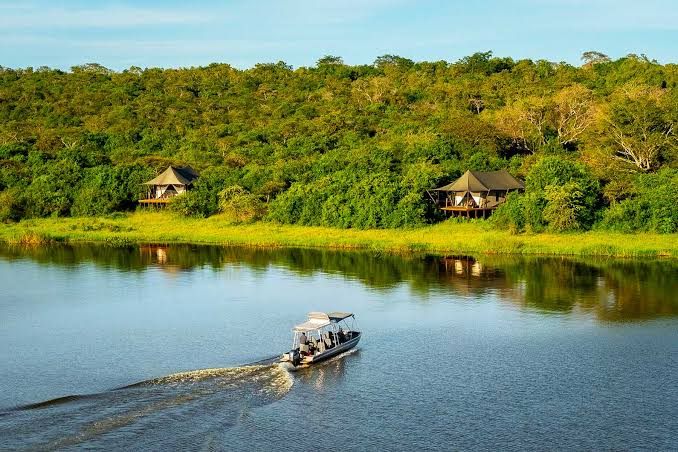
| Southern lakes, around Lake Ihema | The largest of the park’s ten lakes, with hippos, crocodiles, sitatunga in the papyrus and the shoebill; the main gate, headquarters and most activities are here | A first day, boat trips and balloon flights |
| Mutumba Hills, in the centre | Rolling, fenced hills with a campsite and good views | Camping and dawn drives towards rhino and lion territory |
| Kilala and Mohana plains, in the north | The widest open ground, described as the core of lion territory and the most reliable place for lions and rhinos | Predators and open-country game |
| Lake Rwanyakazinga and the Magashi peninsula, in the north-east | A private concession with a luxury camp | Seclusion and walks with guides |
| The eastern wetlands | Papyrus swamps along the Kagera River running the length of the park | Birds and swamp wildlife |
One day covers the southern lakes, a boat trip and a stretch of plains game. Two nights lets you drive the full length of the park, add a night drive and reach the northern plains where the predators are most active, according to one guide.
The Wildlife
| Animal | Where and How | Notes |
| Lions | The northern plains, with the Kilala Plains described as the core of their range | Counts range from about 25 to more than 50, depending on the guide |
| Rhinos | The northern and central plains, and on a rhino tracking drive with a ranger | Black rhinos from 2017 and white rhinos from 2021 and 2025; more than 100 animals in one guide |
| Elephants and buffalo | The savannah and swamp edges | Common across the park |
| Leopards | Mostly nocturnal; best on a night drive | Elusive in the day |
| Giraffes, zebras and antelope | The central and southern plains | Antelope such as waterbuck and impala are common on drives |
| Hippos and crocodiles | Lake Ihema and the river | The lake holds one of East Africa’s larger hippo populations |
| Sitatunga and shoebill | The papyrus swamps and lake margins | Best seen on a boat trip on Lake Ihema |
Akagera’s savannah is open and rolling, so wildlife is easy to see, and the park’s wetlands, claimed in several guides to be the largest protected wetland in Central Africa, add birds and water animals. Our separate guide to wildlife safaris in Uganda compares the neighbouring country’s wildlife parks.
Activities and What They Cost
| Activity | What It Involves | Reported Cost |
| Game drives | Day drives on your own or with a ranger, or in a park vehicle with a driver-guide | A park vehicle costs about US$200 for half a day and US$350 for a full day, for up to seven people, plus entry |
| Lake Ihema boat trip | A morning, afternoon or sunset trip for hippos, crocodiles, waterbirds and the shoebill | About US$35 to US$50 per person |
| Night game drive | About two and a half hours with a park guide, for genets, civets, bushbabies, hyenas and sometimes leopards | About US$40 per adult, US$25 for a child |
| Rhino tracking drive | A drive with a park ranger to improve your chances of rhinos | About US$45 to US$50 per person |
| Hot air balloon flight | Launched from Kayitaba, about five minutes from the southern gate, flying for 45 to 60 minutes at up to about 1,000 metres; the first balloon tours began in 2022 | Confirm with the operator |
| Sport fishing | Lake Shakani, the only place in Rwanda where sport fishing is permitted, for tigerfish | About US$25 a day with your own equipment, and about US$50 a rod at Lake Ihema in another guide |
| Guided bush walks | Offered by some lodges to overnight guests, including Ruzizi Tented Lodge and the Magashi camps | Included or priced by the lodge |
Karenge Bush Camp, reopened in May 2025 with seven canvas tents on the Kilala Plains, now offers a morning rhino monitoring trek with rangers, available only to overnight guests. A couple who take a boat trip and a night drive spend about US$150 to US$180, since 2 x (US$35 + US$40) is US$150 and 2 x (US$50 + US$40) is US$180, before entry. Our separate guide to boat cruises in Uganda explains the comparable cruises across the border.
Fees and Budget
| Item | Reported Cost |
| Entry, foreign non-resident adult | About US$100 per day in the park’s own page, with US$40 to US$50 plus a vehicle fee in others |
| Entry, East African community resident | About RWF 25,000 in one guide |
| Entry, child aged 6 to 12 | About US$50 in the park’s own page |
| Entry, children under 5 | Free |
| Lodging, budget | About US$60 to US$100 per person per night |
| Lodging, mid-range | About US$180 to US$380 |
| Lodging, luxury | About US$400 to US$600, and US$1,500 to US$3,000 or more at Magashi |
| Camping at Mutumba Hills | About US$30 to US$40 per person per night |
Older lodge guides still quote an entry fee of about US$50, which is out of date for most visitors, so confirm the fee with the park. Our separate guide to Rwanda safari prices for 2027 explains how Akagera fits into a wider budget.
Where to Stay and How to Get There
| Level | Examples Named in 2026 Guides | Notes |
| Luxury | Magashi Camp, operated by Wilderness, on the shore of Lake Rwanyakazinga in the north; Ruzizi Tented Lodge on Lake Ihema | Magashi is a private concession; Ruzizi has an eco-luxury feel |
| Mid-range | Akagera Game Lodge near Kigarama, Karenge Bush Camp in the Kilala Plains and Rhino Lodge near the southern entrance | Karenge is small and sociable |
| Budget and camping | Akagera Safari Camp, about 15 minutes from the south gate, and the Mutumba Hills campsite | Camping with rooftop tents is described as the best in Rwanda |
| By road | About two and a half hours from Kigali, by tarmac and then park roads | Many visitors go for two nights |
The southern gate is closest to Kigali, so most itineraries begin in the south and move north. Our separate guide to lodges near Akagera describes the options in more detail.
Best Time to Visit
| Period | Conditions | Notes |
| June to September | The long dry season | Animals concentrate near water, and the park is easiest to explore |
| December to February | A shorter dry season | Good conditions and a busy period |
| March to May | The long rains, with April the wettest | Greener and quieter, with harder tracks |
| October and November | The short rains | Showers and fewer visitors |
Akagera can be visited all year, and boat trips and night drives work in every month. Our separate guide to the best time to visit Rwanda explains each month.
Sample Itineraries and a Current Health Note
| Trip | Plan | Best For |
| 1 long day | Southern lakes, a boat trip and a plains drive, returning to Kigali the same day | A short visit |
| 2 days, 1 night | An afternoon drive, a dawn drive and a Lake Ihema boat trip | The practical minimum |
| 3 days, 2 nights | The southern lakes, then the northern plains, with a night drive and a rhino drive | Lions and rhinos |
| 5 to 6 days, with gorillas | Akagera followed by Volcanoes National Park | Big Five and gorillas |
| 8 to 10 days, the full circuit | Akagera, Volcanoes, Nyungwe and Lake Kivu | Every highlight |
Frequently Asked Questions
How big is Akagera National Park?
About 1,122 square kilometres, though some references give 1,200 or 1,222.
Does Akagera have the Big Five?
Yes, after lions returned in 2015, black rhinos from 2017 and white rhinos from 2021 and 2025.
How much is park entry?
About US$100 per foreign adult per day in the park’s own page, with lower figures in other guides.
How far is it from Kigali?
About two and a half hours by road.
How many days do I need?
Two days and one night as a minimum, and three days to reach the northern plains.