Semuliki National Park – Uganda’s Slice of the Congo Basin
Semuliki National Park is lower, hotter and heavier than the highland rainforests of Bwindi and Kibale, with buttress roots, raffia palms and a canopy that closes overhead, and its animals and birds belong more to central Africa than to the east. The park lies on the floor of the Semuliki Valley, on the western side of the Rwenzori Mountains, and it protects the eastern-most extension of the great Ituri Forest of the Congo Basin, with the Semliki River forming the border with the Democratic Republic of Congo.
At about 219 square kilometres it is small, and it is one of the least visited parks in Uganda. It is, however, among the most prized by birdwatchers, who come for a list of 441 species that includes 46 Guinea-Congo biome species found nowhere else in East Africa. Its other celebrity is a pair of hot springs in a mineral-crusted swamp, so hot that visitors boil eggs in them.
This guide explains Semuliki for travellers deciding whether to go. It covers the park and its setting, the birds, the primates and other wildlife, the Sempaya hot springs and how to reach them, the forest trails and what each offers, the Batwa and cultural visits, the adjacent Toro-Semliki Wildlife Reserve, reported fees, how to get there, the best time to go, an important current note about the border and health in 2026 and the mistakes to avoid.
Semuliki National Park at a Glance
| Question | Short Answer |
| Where | Western Uganda, in the Semuliki Valley west of the Rwenzori Mountains, reached from Fort Portal via the Bundibugyo road |
| Size and status | About 219 square kilometres; managed as a forest reserve from 1932 to 1993 and a national park since |
| Setting | The easternmost extension of the Ituri forest of the Congo Basin; the Semliki River forms the border with the Democratic Republic of Congo |
| Birds | 441 species, about 40 percent of Uganda’s total, with 46 Guinea-Congo biome species found nowhere else in East Africa |
| Other wildlife | About 53 to 60 mammal species and 8 to 10 primate species, and a very large butterfly list |
| Main attractions | The Sempaya hot springs, forest trails and Batwa visits |
| Best months | Dry months for the trails, with birds present all year |
Semuliki is not a park for ticking off big animals. It is a park for birds, forest and a few very unusual sights.
The Forest and Its Setting
Semuliki sits on the floor of the Albertine Rift, and its forest is described in one guide as the only true lowland tropical forest in East Africa. Most of its plants and animals are also found in the Congo Basin forests, and many reach the eastern limit of their ranges here. The area was managed as a forest reserve from 1932 to 1993 before becoming a national park, and the park’s tree and swamp forest communities are more evergreen than those of the highland parks.
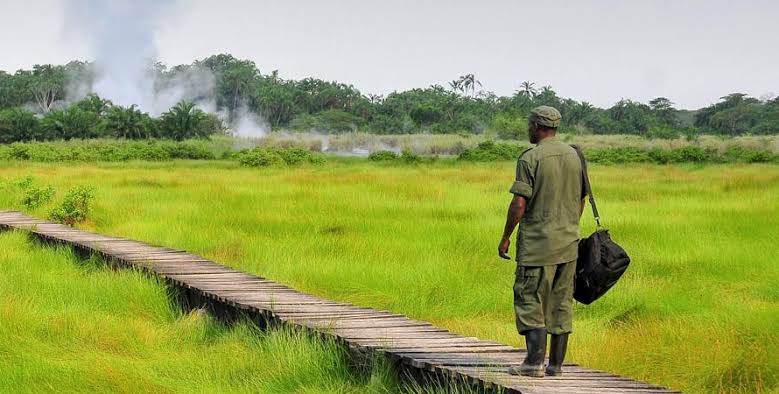
The Semliki River, described as a miniature version of the Congo River, marks the international boundary, and thatched huts shaded by West African oil palms in the surrounding countryside give the area a distinctly central African feel. The local population includes a Batwa community whose people originated in the Ituri forest. Our separate guide to the Rwenzori Mountains explains the mountains that rise to the east.
Birds: The Reason Serious Birders Come
| Topic | What to Know |
| Species count | 441 recorded, about 40 percent of Uganda’s species and 66 percent, or 216, of its forest birds; one guide says over 400 |
| Specialities | 46 Guinea-Congo biome species found nowhere else in East Africa, including hornbills, turacos and weavers |
| Named species | The white-crested hornbill, piping hornbill, red-billed dwarf hornbill, yellow-throated nicator, Ross’s turaco, orange weaver, forest ground thrush and Sassi’s olive greenbul |
| Best places | The Kirumia trail, the Sempaya hot springs area and the Ntandi area |
| Shoebill | One guide lists the shoebill, which should be treated cautiously |
| Guides | UWA rangers lead walks, and a specialist bird guide improves results in dense forest |
Forest birds are hard to see, and early mornings are best. A birding stay of two nights is the minimum for a serious list. Our separate guide to birding safaris in Uganda explains how Semuliki fits with Bwindi, Kibale and Queen Elizabeth.
Primates and Other Wildlife
- Eight to ten primate species are reported, including red-tailed monkeys, grey-cheeked mangabeys and black-and-white colobus on the hot springs trail.
- The rare De Brazza’s monkey is a stronghold on the Red Monkey Trail along the eastern boundary.
- Dent’s mona monkey is among the species named in one guide.
- Mammals total about 53 in one guide and more than 60 in a reference, including forest buffalo that visit the hot springs swamp.
- The park is also known for butterflies, with 628 species claimed in one guide as of March 2026.
- Elephants and other savannah animals are not a feature of the forest, though the adjacent Toro-Semliki Wildlife Reserve offers a more conventional safari.
Wildlife in Semuliki is subtle, and it rewards quiet walking. Our separate guide to wildlife safaris in Uganda explains where to find the larger animals.
The Sempaya Hot Springs
| Topic | What to Know |
| The springs | Two springs: Bintente, called the male in most guides, a broad steaming pool about 12 metres across, and Nyasimbi, the female, a boiling geyser that shoots water up to about two metres; guides disagree on which is which |
| The experience | Water hot enough to boil eggs, in a mineral-crusted swamp that attracts forest buffalo |
| The walk | An hour-long trail to the male spring through forest with red-tailed monkeys, mangabeys and colobus, and a tree house for birdlife; the Sempaya nature trail is about 8 kilometres in total |
| Cultural meaning | The springs are culturally significant to local people, who once boiled food in the pools |
| Cost | About US$5 per person for the hot springs trail in one 2025 guide |
| Nearby | Mungiro Falls near the hot springs, and Batwa dancers at Ntandi |
The hot springs are the park’s best-known sight, and they are easily reached on a half-day visit from Fort Portal. Do not touch the water, and follow the ranger’s instructions on the boardwalk. Our separate guide to Kibale and chimpanzee trekking explains how to pair Semuliki with the Fort Portal area.
Trails and Walks
| Trail | Length and Time | What It Offers |
| Sempaya nature trail | About 8 kilometres | The route to the hot springs, with monkeys, birds and butterflies |
| Kirumia trail | About 13 kilometres in most guides and 8 in one, taking about 4 to 8 hours | The premier forest walk, for birds and rare primates, ending at the Semliki River |
| Red Monkey Trail | About 11 kilometres, around six hours round trip | Along the eastern boundary to the Semliki River, a stronghold of De Brazza’s monkey, with forest and grassland birds |
Nature walks cost about US$40 in one operator page. Take a ranger guide, wear waterproof boots, long trousers and insect repellent and carry plenty of water, since the forest is hot and humid. Our separate guide to what to pack for a Uganda safari includes a base list.
The Batwa and Cultural Visits
The Batwa people living near the park boundary originated in the Ituri forest, and tourism provides them with additional income. A Batwa community visit costs about US$20 per person in one guide, with cultural demonstrations of traditional forest knowledge such as plant use, fire-making and hunting technique, and Batwa dancers perform at Ntandi. Park visitors can also buy handmade crafts.
As elsewhere in Uganda, the best visits are those arranged through community programmes, where the fee is shared and explained. Ask how the money is used, and ask before taking photographs. Our separate guides to cultural tours in Uganda and to community-based tourism explain how to visit well.
Toro-Semliki Wildlife Reserve
Adjacent to the park lies the Toro-Semliki Wildlife Reserve, a protected area of savannah grassland and riverine forest that offers game drives of a more conventional East African character, with Uganda kob, buffalo, oribi and the occasional elephant on the open plains. A lodge inside the reserve is named in one guide as offering an exclusive safari experience.
The reserve is a useful complement to the forest and suits travellers who want a mix of habitats. Our separate guide to Queen Elizabeth National Park explains a larger savannah park a few hours to the south.
How to Get There and Best Time to Visit
| Topic | What to Know |
| Getting there | From Fort Portal via the Bundibugyo road, a journey of a few hours, with the Sempaya gate and hot springs near the park’s main entrance |
| Stay | At least one night, two for birding, with lodges around Fort Portal and Bundibugyo and the reserve lodge |
| Dry months | June to September and December to February, with easier trails |
| Wet months | March to May and October to November, with muddy trails |
| Combine with | Kibale, the Rwenzori Mountains and Queen Elizabeth |
Frequently Asked Questions
How big is Semuliki National Park?
About 219 square kilometres.
How many bird species does it have?
441 recorded, including 46 Guinea-Congo biome species found nowhere else in East Africa.
What are the Sempaya hot springs?
Two boiling springs, called male and female, in a mineral-crusted swamp, hot enough to boil eggs.
How do I get there?
From Fort Portal via the Bundibugyo road, a journey of a few hours.
Is it affected by the Ebola outbreak in Congo?
The park borders the Democratic Republic of Congo, so check current government advice and Uganda Wildlife Authority notices before planning a visit.