Guide to Gorilla Trekking in Africa
Gorilla trekking in Africa: when people talk about gorilla trekking, they usually mean the mountain gorillas of Uganda and Rwanda, and for most travellers that is exactly right. Those two countries offer the most reliable, best-organised and most visited gorilla encounters in the world. But gorillas live in more places than the Virunga mountains, and there are other ways to meet them. In the forests of central Africa, western lowland gorillas can be tracked in parks in the Republic of Congo, the Central African Republic and Gabon.
In the east of the Democratic Republic of Congo, a second mountain gorilla population and the eastern lowland gorilla have long been offered at the lowest permit prices on the continent. This year, one of those options is closed and the region carries serious health and security warnings, so a guide to gorilla trekking in Africa has to be honest about what is possible and what is not.
This guide explains the whole picture. It covers the four kinds of gorilla and where each lives, the countries and parks where trekking is offered, permit prices in 2026, how the experiences differ, the rules that apply almost everywhere, the safety and health position this year, a comparison of costs and difficulty, how to choose and the mistakes to avoid. Where published reports disagree, such as the status of Virunga’s treks, the guide says so. Our separate guides to the Uganda and Rwanda permits and to primate tracking in each country go into detail on the two main destinations.
Gorilla Trekking in Africa at a Glance
| Country and Park | Gorilla | Permit Reported in 2026 | Status and Notes |
| Uganda, Bwindi and Mgahinga | Mountain gorilla | US$800, or US$600 in April, May and November 2026 | Open; the most choice of sectors and families |
| Rwanda, Volcanoes | Mountain gorilla | US$1,500, with a reported US$1,050 multi-park low-season rate | Open; compact and tightly managed |
| DR Congo, Virunga | Mountain gorilla | US$400 in operator pages | Official site reported as closed until further notice because of security |
| DR Congo, Kahuzi-Biega | Eastern lowland (Grauer’s) gorilla | US$400 in operator pages | In the east of the country, near Bukavu; serious security and Ebola warnings |
| Republic of Congo, Odzala-Kokoua | Western lowland gorilla | About US$750 in one 2026 guide | Open to tourism since 2012; packages are expensive |
| Central African Republic, Dzanga-Sangha | Western lowland gorilla | About 350 euros in one guide, bundled into packages | Trekking from Bai Hokou; a specialist trip |
| Gabon, Loango and Moukalaba-Doudou | Western lowland gorilla | About US$900 per trek in one guide | A specialist, premium trip |
For almost every traveller, the practical choice in 2026 is between Uganda and Rwanda. The rest are specialist options, and one is currently not a sensible plan.
The Four Kinds of Gorilla
| Gorilla | Where It Lives | Numbers Reported | Notes |
| Mountain gorilla | The Virunga massif across Uganda, Rwanda and the Democratic Republic of Congo, and Bwindi in Uganda | Close to 1,100 in the Virunga region, according to the Rwanda Development Board, and about 1,063 in one page | The best-known and most visited; found at altitude in cool, wet forest |
| Eastern lowland or Grauer’s gorilla | Lowland forests of the east of the Democratic Republic of Congo | About 3,800 in one operator page | The largest gorilla subspecies; found nowhere else |
| Western lowland gorilla | Forests of Cameroon, the Central African Republic, the Republic of Congo, Gabon, Equatorial Guinea, Angola’s Cabinda and the Democratic Republic of Congo | About 276,000 individuals in one reference; critically endangered | The smallest subspecies and the only one in zoos |
| Cross River gorilla | The Cameroon and Nigeria border region | About 250 to 300 | Not offered for trekking |
The population of the Virunga mountain gorillas has risen from about 430 when Rwanda’s naming ceremony began to close to 1,100 today, which is one of the few good-news stories in great ape conservation.
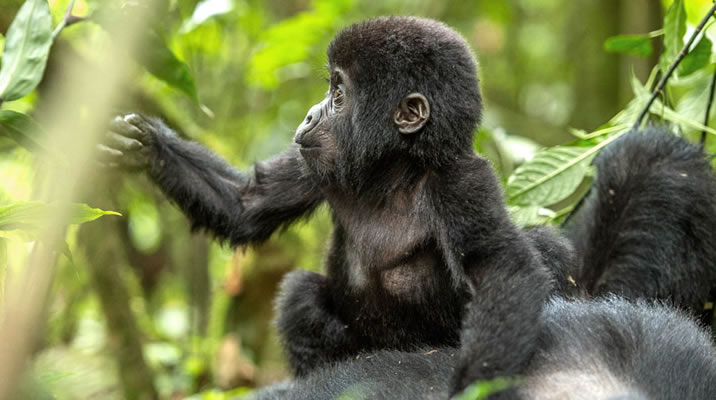
Western lowland gorillas are far more numerous but far harder to find, since they live in dense, remote forest. Our separate guide to Kwita Izina explains how the mountain gorilla story is told in Rwanda.
Uganda and Rwanda: The Two Reliable Destinations
| Feature | Uganda | Rwanda |
| Parks | Bwindi Impenetrable, in four sectors, and Mgahinga | Volcanoes |
| Permit | US$800, or US$600 in the 2026 low-season months; habituation US$1,500 to US$1,800 | US$1,500, with a reported US$1,050 multi-park low-season rate |
| Time with the gorillas | One hour, or up to four hours on the habituation experience | One hour |
| Group size | Up to eight visitors per family per day | Up to eight per family per day |
| Distances | Long drives between parks, with a fly-in option | Short; Volcanoes about three hours from Kigali |
| Character | More families, more sectors and more variety | Compact, polished and easy |
Uganda is cheaper and offers more variety. Rwanda is easier to organise and costs nearly twice as much per permit. Many travellers do both, linking Volcanoes and Bwindi by road via Kisoro. Our separate guides to Bwindi sectors, to the Uganda gorilla permit cost and to the Rwanda gorilla permit cost explain each.
The Democratic Republic of Congo: Virunga and Kahuzi-Biega
The Democratic Republic of Congo is the only country in Africa that offers both mountain gorillas, in Virunga National Park, and eastern lowland gorillas, in Kahuzi-Biega National Park, which is about two hours from Bukavu and is the only place on earth where Grauer’s gorillas can be tracked. Operator pages quote permits of about US$400, a quarter of Rwanda’s price, with some reporting US$200 in the rainy months. Virunga is Africa’s oldest national park, founded in 1925, and its rangers have paid a heavy price to protect it.
In 2026, however, one guide reports that Virunga’s official visitor site states that gorilla treks are closed until further notice because of security, and advises that DR Congo should not be planned around unless reopening and security conditions change. The eastern provinces, including North Kivu and South Kivu, are also affected by the Ebola epidemic that began in May 2026, and the Goma and Bukavu land borders are closed to most travellers. Some operators continue to sell Congo trips. The sensible position is to treat DR Congo gorilla trekking as not available for planning, and to check the park’s own current notice and your government’s advice if you are curious.
Western Lowland Gorillas: Congo, Central African Republic and Gabon
| Park | What It Offers | Reported Cost |
| Odzala-Kokoua, Republic of Congo | An area of about 13,500 square kilometres, established in 1935 and managed by African Parks since 2010, open to tourists since August 2012; trekking habituated western lowland gorilla groups | A permit of about US$750 in one 2026 guide, and all-inclusive packages of 7 to 11 days at about US$11,000 to over US$21,000 per person |
| Nouabale-Ndoki and Mbeli Bai, Republic of Congo | A forest clearing where researchers have monitored more than 330 gorillas since 1995; an observation platform and not a trek | A very expensive, specialist trip |
| Dzanga-Sangha, Central African Republic | The Dzanga Bai clearing for forest elephants, and gorilla trekking from the Bai Hokou habituation site | A permit of about 350 euros bundled into packages, with 7 to 9 day packages of about US$5,600 to US$5,700 per person |
| Loango and Moukalaba-Doudou, Gabon | Western lowland gorillas in forest and coastal landscapes | A permit of about US$900 per trek in one guide |
These are specialist trips. One operator notes that even a budget experience in central Africa can cost more than a luxury safari in Uganda or Rwanda, because of charter flights, remote logistics and small numbers. They are also very different from mountain gorilla treks. The forest is flat or swampy and hot, the animals are more elusive, and the experience is quieter and wilder. Check your government’s advice for each country, since security and health conditions vary.
How a Lowland Trek Differs From a Mountain Trek
| Feature | Mountain Gorilla Trek | Lowland Gorilla Trek |
| Terrain | Steep, muddy slopes at altitude, in cool, wet forest | Lowland rainforest and swamps, often hot and humid |
| Reliability | Very high, with trackers who find the family each morning | Variable, since the animals are more elusive and the forest denser |
| Visitors | Many, with strict group sizes | Few; remote and exclusive |
| Cost | US$800 to US$1,500 for the permit, with moderate lodge costs | Lower or similar permits but high logistics and package costs |
| Style | Well-organised and easy to arrange | Specialist and expedition-like |
Descriptions of the lowland experience in this table are general and were not drawn from detailed trek reports. They reflect the differences in habitat that guides describe. Your operator should be able to explain the specific trek in each park.
Rules That Apply Almost Everywhere
- The minimum age is 15 in Uganda, Rwanda and the Democratic Republic of Congo, and similar rules are common elsewhere.
- A valid permit is required in advance, in your name, with passport details at booking, and payment is typically made in full upfront.
- A family can be visited by a limited number of people per day, with eight a standard figure.
- Visitors stay about seven metres from the gorillas, and the time with them is about an hour.
- Flash photography is not allowed.
- Visitors who are unwell may be refused, since gorillas are vulnerable to human diseases.
- Permits include park entry but not transport, lodging, porters or tips.
The rules exist to protect the animals, and rangers will brief you before every trek. Our separate guide to gorilla trekking packing explains what to wear for the trek.
Safety, Health and Entry
| Topic | What Is Reported |
| Ebola | An epidemic of Bundibugyo virus disease in eastern Democratic Republic of Congo since May 2026, with the World Health Organization declaring a public health emergency of international concern; about 9,964 confirmed cases and 4,851 deaths as of 25 October 2026 |
| Uganda | Recorded 20 cases and two deaths earlier in 2026 and says it is currently Ebola-free; restricts travel from the Democratic Republic of Congo and bars transit for travellers with a recent history there |
| Rwanda | Screens arrivals and restricts entry for foreigners who recently visited the Democratic Republic of Congo; Goma and Bukavu crossings closed to most travellers |
| Eastern DR Congo | Governments advise against travel; Virunga treks reported closed |
| Yellow fever | A certificate is mandatory for Uganda and required in Rwanda if you arrive from a risk country |
| Mountain gorilla parks | Described as far from the Ituri epicentre, with permits not suspended in Uganda or Rwanda in the reports reviewed |
The World Health Organization advises against travel and trade restrictions, while governments apply their own rules. Fly directly to Uganda or Rwanda where you can, keep your travel history straightforward and check the latest advice before you book. Our separate Uganda and Rwanda travel guides explain the entry rules.
Comparing the Costs:
| Party | Uganda | Rwanda |
| One trekker | US$800 | US$1,500 |
| A couple | 2 x US$800 = US$1,600 | 2 x US$1,500 = US$3,000 |
| A family of four aged 15 or over | 4 x US$800 = US$3,200 | 4 x US$1,500 = US$6,000 |
| The same family in the 2026 low season | 4 x US$600 = US$2,400 | 4 x US$1,050 = US$4,200, if the discount applies |
| The difference per person at peak | US$700 less than Rwanda | US$700 more than Uganda |
The gap of US$700 per trekker adds up quickly for families, though Rwanda’s shorter distances can save on vehicles and time. Our separate guides to Uganda and Rwanda safari prices for 2027 explain the full budgets.
How to Choose
| If You Are | Choose | Why |
| A first-time visitor with a moderate budget | Uganda | A lower permit and more variety |
| Short of time and wanting ease | Rwanda | Compact and polished |
| Wanting more time with the gorillas | Uganda’s habituation experience | Up to four hours with four visitors |
| Wanting both countries | Rwanda then Uganda via Kisoro | A natural overland link |
| A specialist traveller with a large budget | A western lowland trek in Congo or Gabon, after checking advice | A very different, remote experience |
| Looking at the cheapest permit | Do not plan around DR Congo in 2026 | Reported closed, with security and Ebola warnings |
If you are unsure, choose Uganda or Rwanda, book three to six months ahead and pay for the permit through a licensed operator. Our separate guide to choosing a trusted Uganda safari company explains how to check.