Nyungwe National Park – Rwanda’s Ancient Rainforest
Nyungwe National Park is vast, dark and green, a montane rainforest of about 1,019 square kilometres in the south-west, along the border with Burundi, rising from about 1,480 to 2,950 metres. Rangers have protected it since 1933, it became a national park in 2005 and in September 2023 it was inscribed on the UNESCO World Heritage List.
It holds 13 primate species, which is said to be a quarter of all of Africa’s primates, a bird list of about 322 species including some 30 Albertine Rift endemics, a lattice of trails through ferns and orchids and, since 2010, a suspended walkway that carries visitors out above the treetops. Troops of Rwenzori colobus monkeys run into the hundreds, and chimpanzees live in several communities. It is a forest to walk, not to drive through.
This guide explains Nyungwe for travellers planning a trip. It covers the park’s history and status, the primates and how to see them, chimpanzee tracking and its conflicting fees, the canopy walk and what to expect on it, the trails and gates, birds and other wildlife, the tea estates and cultural visits, where to stay and how to get there, the best time to go, sample itineraries, a note on the current border and health advice and the mistakes to avoid. Published figures differ on the canopy walk’s height and price and on the chimpanzee permit, and the guide gives the ranges. Our separate guides to primate tracking in Rwanda, to birding safaris and to chimpanzee trekking in Uganda and Rwanda go into more detail.
Nyungwe National Park at a Glance
| Question | Short Answer |
| Where | South-west Rwanda, along the border with Burundi, about 225 kilometres and five hours by road from Kigali |
| Size and altitude | About 1,019 square kilometres, from about 1,480 to 2,950 metres |
| Status | A forest reserve since 1933, a national park since 2005 and a UNESCO World Heritage Site since September 2023 |
| Primates | 13 species, including chimpanzees, Rwenzori colobus and golden monkeys |
| Birds | About 322 species in the official count, with about 30 Albertine Rift endemics |
| Chimpanzee permit | US$150 or US$250 in 2026 guides |
| Canopy walk | A suspended walkway of about 160 metres, at about US$60 |
| Best months | June to September and December to February, though the forest is wet at any time |
Give Nyungwe at least two nights. A single day on the road and a single walk does not do it justice.
The Forest, Its Status and Its Conservation
Nyungwe lies on the Congo-Nile divide in a part of the Albertine Rift, and it is one of the largest remaining blocks of montane forest in East and Central Africa. It was protected as a forest reserve from 1933 and became a national park in 2005, and it is managed with the support of African Parks under a long-term commitment with the Rwandan government. One reference counts 85 mammal species, about 1,068 plant species, 32 amphibians and 38 reptiles.
Its World Heritage listing in September 2023 recognised it as the first natural site in Rwanda to be inscribed. The forest is a water tower for the region, and its streams feed rivers that flow towards both the Congo and the Nile. The park is cool, humid and often misty, with rain possible in any month. Our separate guide to Rwanda’s national parks explains how Nyungwe fits with Volcanoes and Akagera.
The Primates
| Primate | Notes |
| Chimpanzee | Several communities, with tracking from the main forest and from the Cyamudongo forest in the south-west |
| Rwenzori colobus | Large troops, with hundreds of animals in the largest, seen on walks and a colobus tracking activity |
| Golden monkey | Listed in Nyungwe in one guide, as well as in Volcanoes |
| L’Hoest’s monkey | A forest guenon associated with the Albertine Rift |
| Blue, red-tailed and other monkeys | Seen on forest walks |
| Others | Olive baboon, vervet, grey-cheeked mangabey, Dent’s mona and owl-faced monkey in guides |
The primate lists differ slightly between guides, but the count of 13 is widely used. The forest is also home to leopards, servals and other mammals that are rarely seen. Our separate guide to wildlife safaris in Uganda explains where else to see forest primates.
Chimpanzee Tracking
Chimpanzee tracking in Nyungwe is a forest trek led by rangers and trackers to a habituated community, followed by about an hour of observation. The permit is US$150 in one 2026 guide and US$250 in another, and earlier research for this series found US$90, so confirm the fee for your dates. Tracking from the Gisovu gate in the south-west reaches the Cyamudongo forest, a separate patch of forest where chimpanzees can be found, while other treks start in the main forest.
Trails are steep, humid and often muddy, and sightings are less predictable than at Kibale in Uganda, which has the largest chimpanzee community in East Africa. The reward is the forest itself and the other primates met on the way. Wear waterproof boots, long sleeves and gloves, and carry a rain jacket. Our separate guide to chimpanzee trekking in Uganda and Rwanda compares the forests.
The Canopy Walk
| Topic | What to Know |
| What it is | A suspended walkway of about 160 metres in three sections of about 90, 45 and 25 metres, built in 2010 with USAID support through the Green Heart organisation |
| Height | About 70 metres above the ravine at its highest point in most guides, with 74 and 50 metres in others |
| Getting there | A guided walk along the 2.1 kilometre Igishigishigi trail from the Uwinka reception centre, with a total time of about one and a half to two hours |
| Difficulty | Easy, though the height is a challenge for anyone afraid of heights |
| Age | A minimum of six years, with children accompanied by an adult |
| Cost | About US$60 per foreign non-resident in several 2026 pages, though an older breakdown gave US$40 plus park entry |
| Claimed distinction | Described as the third of its kind in Africa and the only one in East Africa |
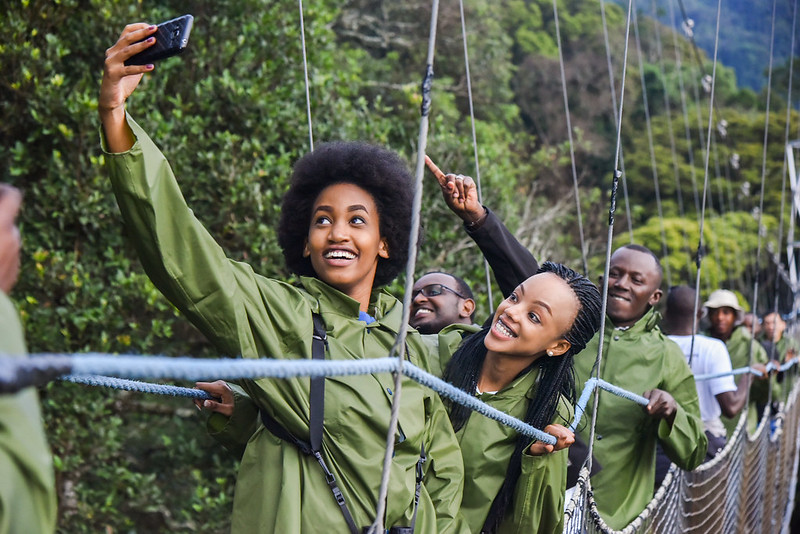
The walk is best in the dry season, when the walkway is drier and the views clearer, and early in the morning for birds and light. The walkway puts you at eye level with the canopy, and it is one of the best places to see forest birds and butterflies. Our separate guide to birding safaris in Rwanda explains what to look for.
Trails, Gates and Other Activities
| Gate or Area | What It Offers | Notes |
| Uwinka, the centre | The park headquarters and reception centre, with most hikes and the canopy walk | The main hub for visitors |
| Gisakura, in the north | Birding, primate walks and tea estates | Close to several lodges |
| Gisovu, in the south-west | The gateway to Cyamudongo for chimpanzee tracking | A separate forest patch |
| Kitabi, in the east | Cultural trails and community visits | A good place to meet local people |
| Igishigishigi trail | 2.1 kilometres, the route to the canopy walk | Easy |
| Kamiranzovu swamp trail | About 6.5 kilometres to a swamp with rare plants and good birding | A longer guided walk |
| Bigugu trail | About 13.2 kilometres to Mount Bigugu, at about 2,921 to 2,950 metres | The most demanding walk |
Guided hikes cost about US$40 to US$100 depending on the trail, according to one page, and colobus tracking is about US$40 in one guide. Hire a guide and a porter for the longer walks. Our separate guide to what to pack for a Rwanda safari includes a base list for forest walking.
Birds and Other Wildlife
- About 322 species are listed in the official count, with about 30 Albertine Rift endemics, though other guides give 300 to 340 and 29 to 31 endemics.
- The red-collared mountain babbler is described as the most popular bird in the park, and others include the Rwenzori turaco, the Albertine owlet, the dusky and Shelley’s crimsonwings and several sunbirds.
- Forest birds are hard to see because most stay high in the canopy, so a local guide who knows the calls makes a large difference.
- The park also holds leopards, servals, giant forest hogs and a rich variety of butterflies and orchids.
- The Kamiranzovu swamp and the tea estates at Gisakura are good places for birds.
Nyungwe is the best forest birding site in Rwanda. Our separate guide to birding safaris in Rwanda explains how to plan a birding trip.
Tea Estates and Cultural Visits
The forest is bordered by tea estates, particularly around Gisakura, where the plantations climb the ridges in neat green rows and several lodges look out over them. A tea estate visit shows how Rwanda’s best-known crop is grown and processed, and it makes a gentle afternoon after a walk. Community visits at Kitabi and around the park offer a view of local life and crafts.
As elsewhere in Rwanda, choose community-run visits and ask how fees are shared. Our separate guide to cultural tours in Rwanda explains how to visit well.
Where to Stay and How to Get There
| Level | Examples Named in Guides | Notes |
| Luxury | One&Only Nyungwe House and Nyungwe Tea Forest Resort | Named among the country’s most exclusive lodges; rates to confirm |
| Mid-range and budget | Lodges and guesthouses around Gisakura, Kitabi and Uwinka | From simple guesthouses to comfortable lodges |
| Camping and the Forest of Hope guesthouse | A guesthouse with two twin rooms and a campsite inside the park in one reference | Limited |
| By road | About 225 kilometres and five hours from Kigali to Uwinka, often broken at Huye and Nyanza | A full day |
| By road from Lake Kivu | From Rusizi or Karongi along the lake, a scenic drive | A common link on a circuit |
Many travellers split the drive from Kigali with a stop at the King’s Palace in Nyanza and the Ethnographic Museum in Huye. Our separate guides to lodges near Nyungwe and to Lake Kivu describe the options.
Best Time to Visit and Sample Itineraries
| Period or Trip | Notes |
| June to September | The long dry season, with the easiest trails and the clearest walkway views |
| December to February | A shorter dry season with good conditions |
| March to May and October to November | The rains, with muddy trails and heavy cloud, though the forest is lush and quiet |
| 2 to 3 days | Chimpanzees, the canopy walk and a tea estate visit |
| 4 days, with Lake Kivu | Nyungwe for two nights, then Karongi or Rusizi on the lake |
| 7 days, primates | Volcanoes for gorillas and golden monkeys, then Nyungwe for chimpanzees and colobus |
| 9 to 10 days, birds and wildlife | Akagera, Nyungwe, Gishwati-Mukura and Volcanoes |
Frequently Asked Questions
How big is Nyungwe National Park?
About 1,019 square kilometres, a UNESCO World Heritage Site since September 2023.
How many primate species does it have?
13, including chimpanzees and large troops of Rwenzori colobus.
How much is chimpanzee tracking?
US$150 in one 2026 guide and US$250 in another, so confirm the fee.
How long is the canopy walk?
About 160 metres, at about 70 metres high in most guides, costing about US$60.
How far is it from Kigali?
About 225 kilometres, or about five hours by road.
If you would like help planning a trip to Nyungwe National Park, our team can arrange chimpanzee tracking, the canopy walk and bird guides, choose a lodge and add Lake Kivu or Volcanoes, with a clear, itemised quote.